
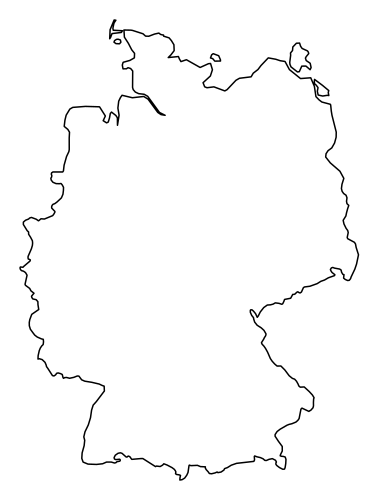
Country Profile · GERMANY
Sustainable Urban Mobility Planning in Germany
On this page
National overview
In Germany, urban transport and mobility planning has a long and well-established tradition. Since the 1960s, many cities have developed strategic transport planning documents, originally focused on traffic management and infrastructure provision. Over time, these evolved into Verkehrsentwicklungspläne (VEPs), which remain the most common planning format used by German municipalities. Another distinctive feature of the German mobility system is the role of regional public transport associations (Verkehrsverbünde), which coordinate public transport services across municipal boundaries.
Although these plans are generally not legally binding in themselves, they play an important role in shaping local investment priorities and guiding long-term mobility policy.
In recent years, German mobility planning has increasingly moved beyond a purely infrastructure-oriented approach. Contemporary VEPs more often combine different transport modes, links with surrounding municipalities, climate objectives, quality-of-life goals, and connections with other urban policy fields such as land use, air quality, and public space. For this reason, many current German mobility plans already include core SUMP features, even if they are not always formally labelled as SUMPs.
Compared with some other European countries, Germany is characterised less by the introduction of an entirely new planning model and more by the gradual adaptation of an existing planning tradition to the principles of sustainable urban mobility. In practice, this means that the German SUMP context is strongly rooted in long-standing municipal planning culture, while recent federal and regional initiatives have helped align this tradition more closely with the European SUMP approach.
National frameworks or requirements
Germany does not have a single nationwide legal obligation requiring all cities to adopt a SUMP. Instead, the national context is based on a combination of established municipal planning practice, professional planning guidance, and an increasing policy emphasis on integrated and sustainable mobility planning. In this setting, VEPs and similar strategic mobility documents function as the main planning instruments used by cities and urban regions.
An important part of the German framework is formed by technical and methodological guidance developed within the professional planning community, especially through transport planning standards and recommendations that encourage integrated, multimodal and participatory planning processes. In addition, recent federal support programmes have explicitly referred to mobility concepts aligned with European SUMP principles, which marks a stronger national recognition of this approach.
At the same time, Germany also shows regional variation. Some Länder have gone further in institutionalising integrated mobility planning. A notable recent example is Baden-Württemberg, where Climate Mobility Plans have been embedded in a structured regional support framework with clear climate targets, modelling requirements and co-funding arrangements. This should, however, be understood as a state-level development rather than a uniform standard across the whole country.
Funding and contact point
For local authorities, one of the most relevant recent developments is the growing connection between integrated mobility planning and public support instruments. Since 2023, the federal level has supported municipalities in preparing or updating sustainable mobility concepts aligned with European SUMP requirements. The first funding call supported 17 projects with a total volume of approximately EUR 5.2 million, and a subsequent call supported additional projects.
A practical national contact point in the German context is NaKoMo — the National Competence Network for Sustainable Mobility. NaKoMo describes itself as a central contact point for sustainable mobility issues across federal, state and local levels, providing networking, knowledge exchange and practical support for municipalities.
Contact point: Nationales Kompetenznetzwerk für nachhaltige Mobilität / NaKoMo Website: https://www.nakomo.de/
Federal Ministry of Transport / Bundesministerium für Verkehr SUMP information page: https://www.bmv.de/SharedDocs/DE/Artikel/G/foerderprogramm-sump.html
Data and monitoring
In Germany, sustainable mobility planning is increasingly linked with diagnosis, analytical evidence, monitoring and evaluation. Modern Verkehrsentwicklungspläne and related mobility plans increasingly incorporate stakeholder participation, monitoring and continuous planning cycles, which brings them closer to the logic of SUMP. This indicates that the role of data is not limited to plan preparation alone but is also relevant for assessing progress and updating measures over time.
This direction is reinforced by research and methodological work at national level. For example, the German Institute of Urban Affairs (Difu) has examined how far existing mobility plans in German municipalities correspond to future EU SUMP standards, including in larger cities and TEN-T urban nodes. This shows that comparability, evidence and plan quality assessment are becoming increasingly important within the German planning context.
Downloadable examples
Kiel — Verkehrsentwicklungsplan
Flensburg masterplan– Bericht_Masterplan_Mobilität.PDF
Flensburg catalogue of measures — 2018 10_Flensburg MaMo_Maßnahmenkatalog.pdf
Wismar — Verkehrsentwicklungsplan
Frankfurt am Main — Masterplan Mobilität
Augsburg — Mobilitätsplan
References and links
National platform and guide to sustainable mobility planning in Germany — nachhaltig.mobil.planen.
EU Urban Mobility Observatory — Germany
EU Urban Mobility Observatory — German case studies
EU Urban Mobility Observatory — Fostering sustainable mobility in North Rhine-Westphalia (Germany)
German Institute of Urban Affairs
BMV — A study on German SUMP readiness, published in 2023
BMV — A research on sustainable urban mobility indicators recommendations