
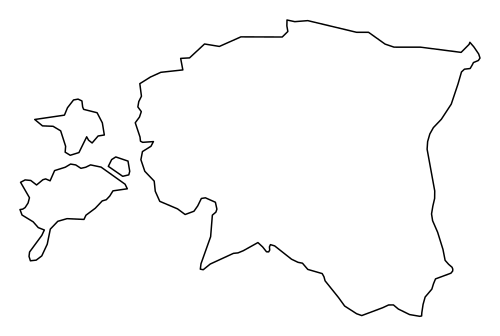
Country Profile · ESTONIA
Sustainable Urban Mobility Planning in Estonia
On this page
National overview
In Estonia, sustainable urban mobility planning has developed within a broader transition from traditional transport planning towards a more integrated mobility approach. Rather than relying on one long-established national SUMP system, Estonia has gradually incorporated sustainable mobility into national transport policy, urban development debates and local planning practice. This shift is visible both in national policy documents and in the emergence of city- and region-level mobility strategies, especially in and around Tallinn.
A distinctive feature of the Estonian context is that mobility planning has evolved under conditions of relatively limited formal obligation but increasing strategic recognition. There is no specific legal requirement for municipalities to prepare an urban mobility or transport development plan as a SUMP-type document, and the Estonian approach has not been based on making SUMPs binding by default. At the same time, the country has moved towards stronger policy support for sustainable mobility through national planning and transport strategies.
In practice, this means that Estonia’s SUMP landscape has developed in a more flexible and experimental way than in countries with a fully formalised national framework. The need for integrated mobility planning has been shaped by rapid urban change, increasing travel demand, environmental pressures and the growing importance of public transport, walking and cycling in urban policy. This is particularly visible in the Tallinn region, where mobility planning has increasingly been approached at a wider metropolitan scale rather than only within the administrative boundaries of the capital city.
Another important characteristic of the Estonian context is the growing link between mobility planning and climate policy. The national Transport and Mobility Development Plan 2021–2035 explicitly aims to reduce the environmental footprint of transport, promote sustainable mobility and increase the share of public transport, walking and cycling, including in urban areas. This gives sustainable urban mobility a clearer strategic position within the national policy framework than was previously the case.
Compared with countries where SUMP implementation is driven mainly by a long-standing domestic planning tradition, Estonia stands out as a case in which sustainable mobility planning has been advancing through policy modernisation, targeted guidance and selected regional initiatives. Its development has therefore been shaped both by national strategic reform and by the growing practical need for coordinated urban and metropolitan mobility planning.
National frameworks or requirements
Estonia does not have a nationwide legal obligation requiring all municipalities to adopt a SUMP as a distinct planning instrument. The law on local government organisation requires a general urban development plan, but not a dedicated integrated mobility plan of the SUMP type. This means that sustainable mobility planning has not been introduced through a single binding legal requirement.
The main strategic framework is now provided by the Transport and Mobility Development Plan 2021–2035, which sets national objectives for convenient, accessible, safe, smart and sustainable mobility. The document explicitly addresses urban mobility, aims to increase the share of public transport and active modes, and includes investment directions for sustainable urban mobility, such as bicycle paths, light rail and multimodal hubs.
The national framework is based mainly on strategic guidance, coordination and gradual institutional development rather than mandatory SUMP rules. National-level work has addressed mobility planning as well as pedestrian and cycling planning, while legal and ownership issues related to initiating SUMP processes have been identified as important implementation challenges. This gives the Estonian model a more flexible and practice-oriented character than a system based on a formal statutory SUMP obligation.
The most recent national-level policy documents include the Estonian Cycling Strategy 2040 and the Public Transport Reform Concept (Ministry of Regional Affairs and Agriculture), both of which support the implementation of SUMP principles at regional and national levels. In addition, the national spatial plan currently in the final stages of preparation is expected to provide clearer guidance for the implementation of sustainable spatial planning and mobility across Estonia.
Under the new TEN-T Regulation, Tallinn and Tartu regions are required to prepare SUMPs by the end of 2027 and work on these plans has already begun.
Funding and contact point
Estonia supports sustainable urban mobility mainly through its national transport policy framework and related investment priorities, rather than through a separate funding instrument dedicated only to SUMP preparation. The Transport and Mobility Development Plan 2021–2035 includes investment directions for sustainable urban mobility, such as bicycle paths, light rail, multimodal hubs and the greening of public transport. The planned support for these measures amounts to approximately EUR 200 million, with financing linked to EU structural funds and EU emissions trading revenues.
Under the TEN-T Regulation, the Tallinn and Tartu regions are required to prepare SUMPs by the end of 2027, and work on these plans has already begun.
The main national institutional reference is the Ministry of Climate, which is responsible for mobility policy within the Estonian government structure.
Estonia’s official SUMP national contact point:
Ministry of Climate
Email: info(at)kliimaministeerium.ee
Estonia’s official SUMP national contact person:
Merlin Rehema
merlin.rehema@kliimaministeerium.ee
605 4300
Data and monitoring
In Estonia, sustainable mobility planning is increasingly linked to measurable targets, impact assessment and policy monitoring. The Transport and Mobility Development Plan 2021–2035 contains quantified indicators, including targets for energy use, renewable energy and the combined share of public transport, cyclists and pedestrians, with interim evaluations planned during the implementation period. This shows that mobility policy is being framed in a more evidence-based and performance-oriented way.
Tallinn, Tartu and Pärnu at a broader regional scale have actively addressed sustainable mobility through various strategies and projects.
Furthermore, alongside spatial planning documents and development strategies, mobility issues have frequently been addressed through local Climate and Energy Action Plans, which have served as another important framework for advancing sustainable mobility initiatives.
The Tallinn region and also Tartu and Pärnu also provide evidence of a monitoring-oriented approach. Materials from the Estonian Transport Administration describe the Tallinn Region Sustainable Urban Mobility Strategy 2035 as setting modal split targets and identifying implementation measures such as integrated ticketing and bicycle network development. This indicates that, at least in the capital region, sustainable mobility planning is associated not only with vision-setting but also with measurable follow-up and implementation planning.
The Estonian Transport Administration is strengthening national capacity for monitoring mobility trends and mobility-related data through several initiatives, including:
- The development of the national multimodal transport model (LAAM)
- The implementation of the Estonian National Mobility Survey (EELU 2026)
- The rollout of a national pedestrian and cyclist counting system on state roads.
Downloadable examples
References and links
EU Urban Mobility Observatory — Estonia member state profile
Ministry of Climate — official website
Transport and Mobility Development Plan 2021–2035
Tallinn 2035 Development Strategy
The Estonian Cycling Strategy 2040
The National Spatial Plan 2050
Public Transport Reform Concept (Ministry of Regional Affairs and Agriculture: